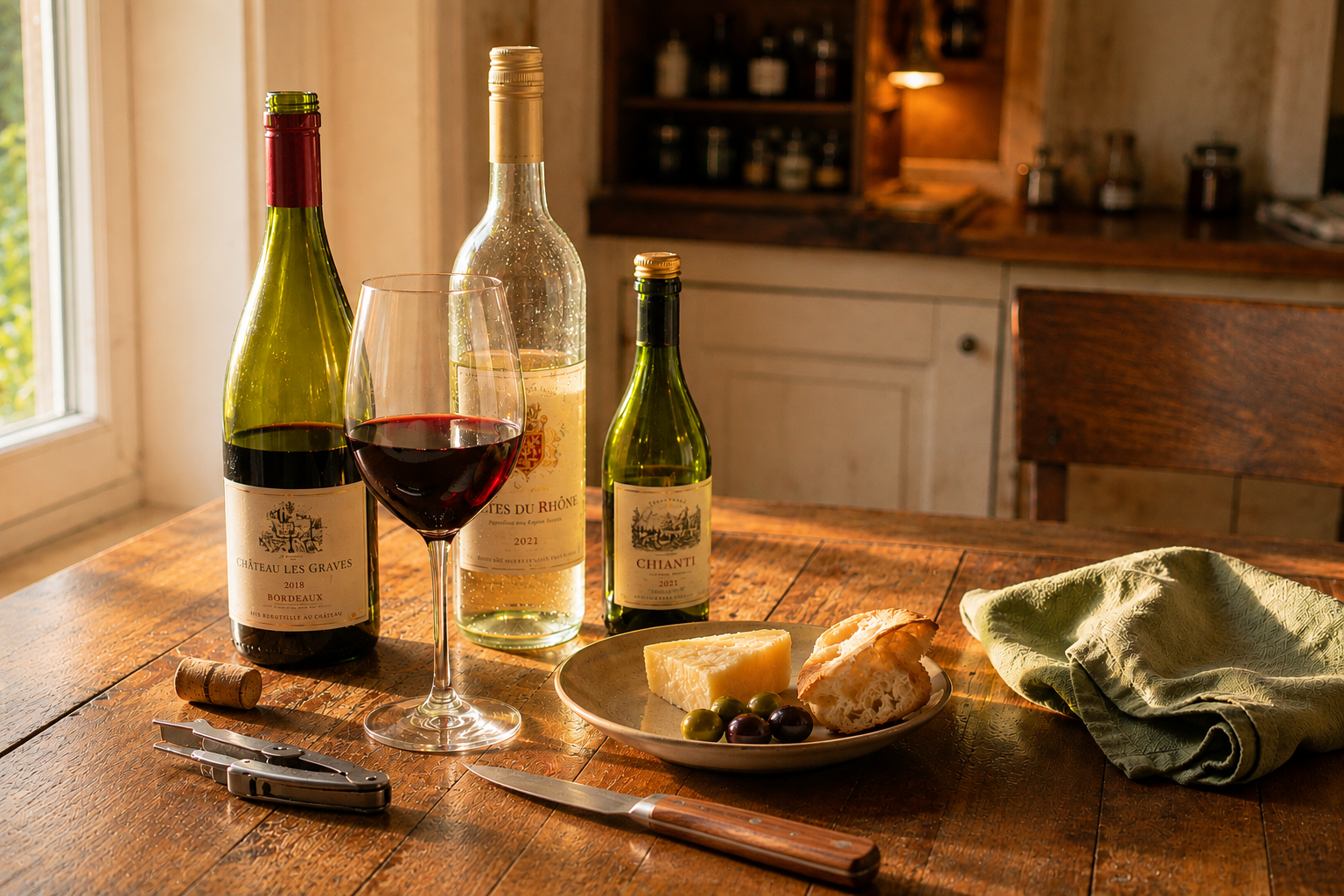
The first rule: skip the famous regions
Famous regions charge a premium for the postcode.
A Chianti DOCG at €8 is mostly a label tax. The same money buys you a much better wine from a less-fashionable region two hours' drive away.
If you are buying Italian, skip Chianti, Brunello, and Barolo at the cheap end. The cheap versions of famous wines are usually disappointing.
Look instead for wines from regions still flying under the radar: Etna Rosso, Aglianico from Basilicata or Campania, Barbera from Asti or Alba, Nero d'Avola from Sicily, Cesanese from Lazio, Refosco from Friuli, Cerasuolo d'Abruzzo for rosé season. All routinely under €10, all routinely better than they have any business being.
If you are buying Spanish, skip the big-name Rioja at the bottom shelf. Look for Mencía from Bierzo, Garnacha from Aragón, or Verdejo from Rueda for whites. Everyday wines doing more work than their price suggests.
If you are buying Portuguese, almost anything works. Portugal is currently the best price-to-pleasure ratio on the European wine map. The Douro, Alentejo, and Dão regions all produce serious wines at unserious prices.
The second rule: learn three importers
In any given country, there are usually two or three small import companies whose wine selections are worth following. They taste hundreds of bottles and only bring in the ones they like.
If you find a wine you love at €9 from importer X, look for other wines from importer X. This trick is overlooked because it requires you to read the small text on the back of the label, which most people don't.
The third rule: ask the shop
If you are buying from an actual wine shop (not a supermarket), ask. "What's a good red under €10 right now?" is the most welcomed question a wine shop owner gets.
They have something specific in mind. They will pull it off the shelf. It will be a good bottle. This costs nothing.
In supermarkets, you don't have this option, but the discount tags near eye level are often a clue. Bottles being moved out at €6 to €8 are sometimes one harvest old and perfectly fine, just rotated to make space for the new vintage.
Red flags on the label
A few signs of a bottle to walk past:
- Cute marketing names (animals, puns, "Old Vine 1987" with no actual vineyard reference). Often soulless industrial wine in a clever bottle.
- "Wine of the European Union." A polite way of saying "we have no idea where this came from."
- A back label that says nothing specific, just adjectives.
Green flags
A specific producer name, a specific region, a vintage year. A back label that says something specific about the wine in real sentences instead of marketing copy. Dark glass. A real cork or a clean modern screw cap (the cheap-looking caps are not).
The whites, which deserve better than a footnote
Everything above leans red, which is how wine writing usually goes and is not
much use in July.
The same logic applies: skip the famous names, buy the unfashionable region.
Verdicchio from the Marche is the best value white in Italy and has been for
twenty years. Fiano and Falanghina from Campania are proper wines at
seven or eight euros. Vermentino from Sardinia or Liguria is what you want
next to anything with tinned fish or olive oil in it. Soave, if it says
Classico and comes from a named producer rather than an industrial one.
Outside Italy: Vinho Verde from Portugal at five euros is the single best
cheap-wine bargain in Europe, Rueda from Spain, and Muscadet from the
Loire, which costs almost nothing and was made for shellfish.
One practical note that matters more than the region. Buy the most recent
vintage you can find. Cheap white wine does not improve with age, it gets
tired, and a bottle two or three years old on a supermarket shelf has usually
been standing under a light the whole time.
What to drink with the food in this book
Not a pairing chart, which nobody has ever used. Four rules that cover almost
everything here.
Tomato needs acidity. Tomato is acidic, and a soft round wine next to it
tastes flat and slightly sweet. Barbera, Nero d'Avola, Cerasuolo d'Abruzzo. This
covers most of the pasta in Part Two.
Pulses and greens want something rustic and dry. Pasta e ceci, pasta e
fagioli, lentil soup, minestrone. A young Aglianico, a Cesanese, a Mencía from
Bierzo. Nothing polished, nothing oaked.
Tinned fish and anything with olive oil raw on it wants a sharp white.
Vermentino, Verdicchio, Vinho Verde. The tuna and cannellini salad with a cold
Vermentino is a genuinely good lunch for about three euros a head.
Egg dishes are harder than they look. Frittata and eggs in purgatory coat
your mouth in fat, and tannin fights it. Go white, or go to a light red served
cool: a Barbera or a young Etna Rosso, twenty minutes in the fridge first.
If you remember one thing: serve cheap red slightly cool, sixteen degrees
rather than room temperature. Warm cheap red tastes of alcohol and jam. Twenty
minutes in the fridge costs nothing and improves an eight euro bottle more than
spending twelve would.
Drinking a bottle alone, over several days
The awkward part nobody writing about wine addresses: a bottle is five glasses,
and one person having a glass with dinner has four left.
The honest position is that an opened bottle is fine for two to three days, and
noticeably tired after four. Not undrinkable. Just flatter, because oxygen has
been at it.
Three things help, in order of how much.
Put the cork back in and put it in the fridge, red included. Cold slows
oxidation. Take the red out twenty minutes before you want it, which is the
same twenty minutes recommended above, so this costs you nothing at all.
Stand it upright, so the least possible wine surface is touching air.
Buy the half bottle when it exists, and do not be embarrassed about it. Many
good producers bottle at 375 ml, it is exactly two glasses, and it is the
correct format for one person on a Tuesday.
What genuinely does not help: those vacuum pump stoppers, which remove a little
air and a little aroma with it. The fridge does more.
The 80% rule
If you follow the above, roughly four in five bottles you bring home under €10 will be drinkable to genuinely good. The fifth will be okay-ish.
This is a much higher hit rate than blind shopping, and a much higher hit rate than buying €15 to €20 wines from the discount section, where the ratio is the same.
The bottom shelf is not a punishment. It's where most of the wine in Europe has lived for centuries, and a good chunk of it is excellent. You just have to know which bottles to pick up. The €4 you saved goes well with dinner.