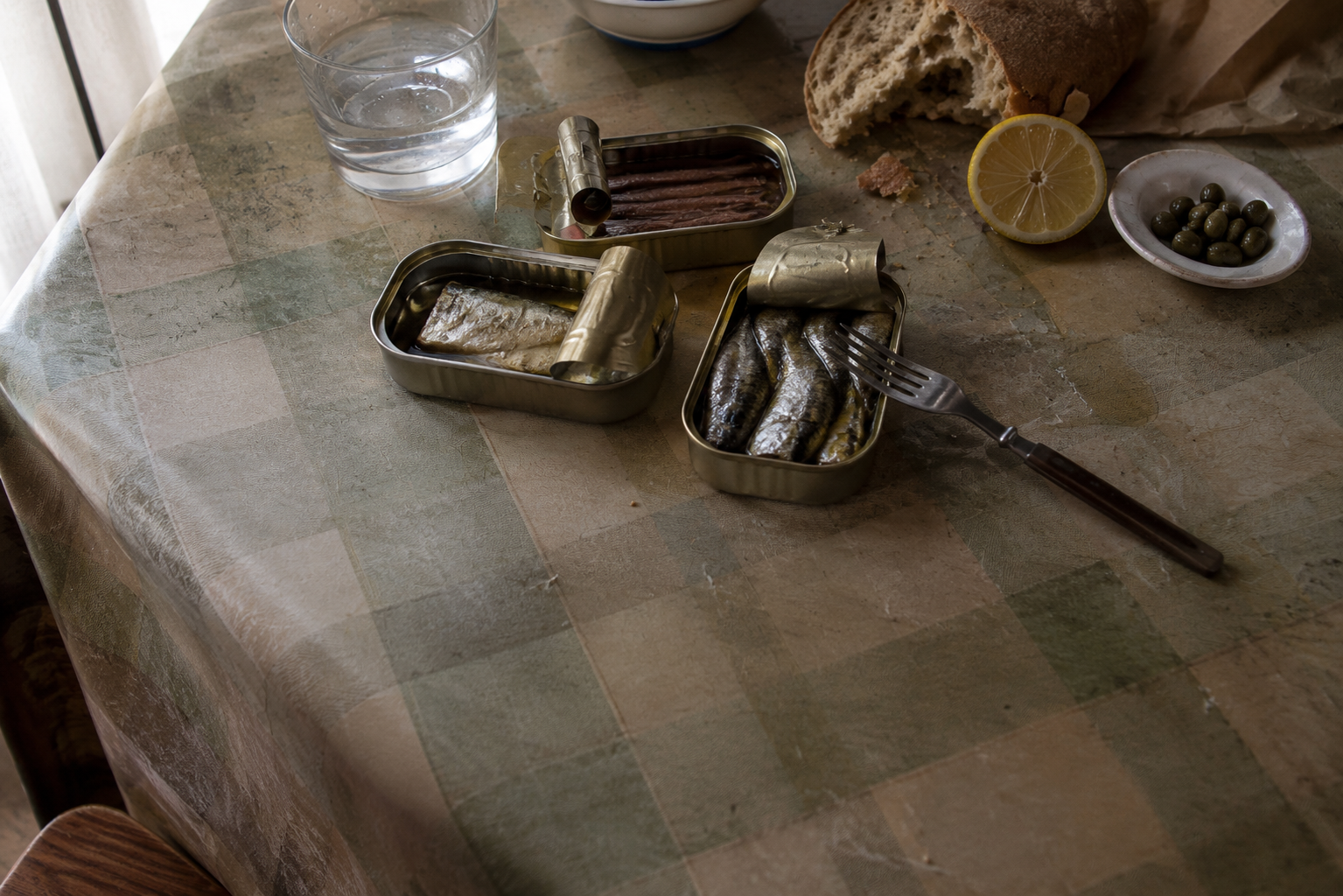
Why tinned is good, not a compromise
The romance of "fresh" gets a lot of press, but most fresh fish at most supermarkets is at least two days post-catch, often more.
Tinned fish, by contrast, is processed within hours of catch and sealed in oil that preserves it indefinitely.
The result is a product that is, in many cases, fresher than the fresh thing. Plus you can eat it on a Tuesday at 9pm without a recipe.
The big four to keep in stock
Four cans is enough.
Sardines in olive oil. The workhorse. €2 to €4 a tin. Eat on toast with lemon, mash on pasta with garlic, fold into a bowl of beans, throw on salad.
Anchovies in olive oil or salt. Not for eating directly (well, sometimes), but the single most underused flavour builder in your kitchen. Two anchovy fillets melted in oil with garlic at the start of a tomato sauce, a braise, a dressing, a stew: the dish does not taste fishy. It tastes deeper. The Italian word is sapore and there is no good English equivalent.
Tuna in olive oil. Avoid the tuna in water unless you are running a cafeteria. The good stuff (Italian, Spanish, or Portuguese ventresca or yellowfin in olive oil) costs €4 to €8 a tin and is a small luxury. Mix into pasta with capers, pile onto white beans with raw onion and parsley, dress a salad of green beans and potato.
Mackerel (sgombro) fillets in oil or sauce. Bigger fish, richer flavour. A tin makes lunch. Eat on bread with mustard and pickled onion if you want to feel like you know things.
Three meals tinned fish unlocks
A few that have saved many evenings.
The first is pasta puttanesca with tinned tuna or anchovy: tomato, olives, capers, anchovy or tuna, chilli. Twelve minutes. Tastes like a restaurant.
The second is a "pantry plate" for one. Open the tin, plate the fish on a piece of good bread, drizzle with the oil from the tin, scatter parsley, lemon, sea salt. Done. Three minutes. A meal.
The third is white beans with tuna. Drained tin of cannellini, drained tin of tuna, raw red onion thinly sliced, parsley, olive oil, lemon, salt. Costs nothing, eats like a small Sicilian holiday.
What to look for on the label
Two things matter.
The oil it's packed in. Olive oil is best (the oil itself is part of the dish you'll eat). Sunflower or vegetable oil is fine but flatter. "Spring water" tuna is for a different category of cooking entirely; skip it.
The country of origin. Italian, Spanish, Portuguese, or French tinned fish from a real fishery is almost always good. The deep-discount stuff that says "product of multiple countries" is not as carefully processed and you can taste the difference.
The one tin worth paying more for
Most of a store cupboard is a commodity. The supermarket chickpeas and the
branded chickpeas frequently come off the same production line with different
paper on them, and nobody has ever identified the difference in a finished dish.
Tinned fish is the exception, and it is worth understanding why, because it is
not snobbery.
In almost every dish it appears in, the fish is the protein carrying the entire
plate. Tuna with white beans. Pasta with tuna, olives and capers. A tin opened
onto good bread with lemon. Three or four ingredients, one of which is the tin,
and it has nowhere to hide. Compare that with tinned tomatoes, which vanish into
a sauce with garlic, oil and forty minutes of heat, and where the cheap tin
genuinely is the same thing.
So buy the supermarket pulses, buy the supermarket passata, and put the
difference into the fish. A four euro tin of tuna in olive oil against a one
euro tin in brine is not a price increase for a marginal gain. It is a different
ingredient, and it changes the dish more than any technique in this note.
How to melt an anchovy
The article calls anchovies the most underused flavour builder in the kitchen
and then does not say how to use them, which is the gap that keeps the tin
unopened.
The technique, in full. Warm two or three tablespoons of olive oil in a pan
over a low heat. Add two anchovy fillets and a crushed clove of garlic. Stir
with a wooden spoon and press the fillets against the base of the pan. In sixty
to ninety seconds they will stop being fish and dissolve into the oil, and the
smell changes from fishy to savoury.
That is it. From there add tomatoes, or greens, or breadcrumbs, or nothing at
all and toss it through pasta.
Low heat matters. Anchovies burn, and burnt anchovy is bitter and
unrescuable. If the oil is shimmering when they go in, it is too hot.
Two fillets is the dose for a dish serving two. At that quantity nobody
tastes fish, they taste depth. Four and it starts to announce itself. Six and
you have made an anchovy dish, which is also a fine thing to have done, on
purpose.
Where it earns its place: broccoli or cavolo nero with pasta, a tomato sauce
that tastes thin, roast peppers, anything with cauliflower, and a dressing for
bitter leaves. It is also what makes the difference between a home puttanesca
and a good one.
A tin costs about 2 euros, keeps for two years in a cupboard and once opened
keeps a fortnight in the fridge under a film of oil. There is no other ingredient
in this price range that does as much.
Reading a tin of sardines
The labels look interchangeable and are not.
Whole or fillets. Whole sardines include the backbone, which is soft, edible
and where most of the calcium is. Fillets are boneless, more expensive and
slightly less interesting. If the bone bothers you, buy fillets and pay for the
privilege rather than picking them out.
Skin on or off. Skin on is the default and the better buy. Skinless is
tidier on a plate and blander.
The count. A tin marked 3/4 holds three or four large fish, 10/12 holds ten
or twelve small ones. Bigger fish are meatier and better on toast; small ones
are more delicate and better mashed into pasta or beans.
In olive oil, in sunflower oil, or in tomato. Olive oil is worth the extra
euro, because the oil is part of the dish and you will pour it over the fish
rather than draining it. Sunflower is fine and flatter. Tomato sauce versions are
a different product entirely, closer to a ready meal, and they are perfectly
good on bread with no further work.
Date. Unlike most tinned things, sardines genuinely improve for a year or
two in the tin as the flesh softens into the oil. A tin two years from packing
is not a compromise, it is the way the Portuguese prefer them.
A quiet luxury
There is also a small upper tier of tinned fish that is genuinely a luxury: Cantabrian anchovies, Spanish ventresca, French sardines from specific producers. These cost €10 to €20 a tin and are absurdly good.
Reserve for a slow Sunday lunch with bread and wine, or for impressing one specific friend who you suspect knows about food. Try one once a year. You will think differently about the rest of the aisle for a while afterward.
The can in your cupboard is most often dinner. Stock four of them at all times and the worst night of the week becomes recoverable in five minutes. That's the whole tip.