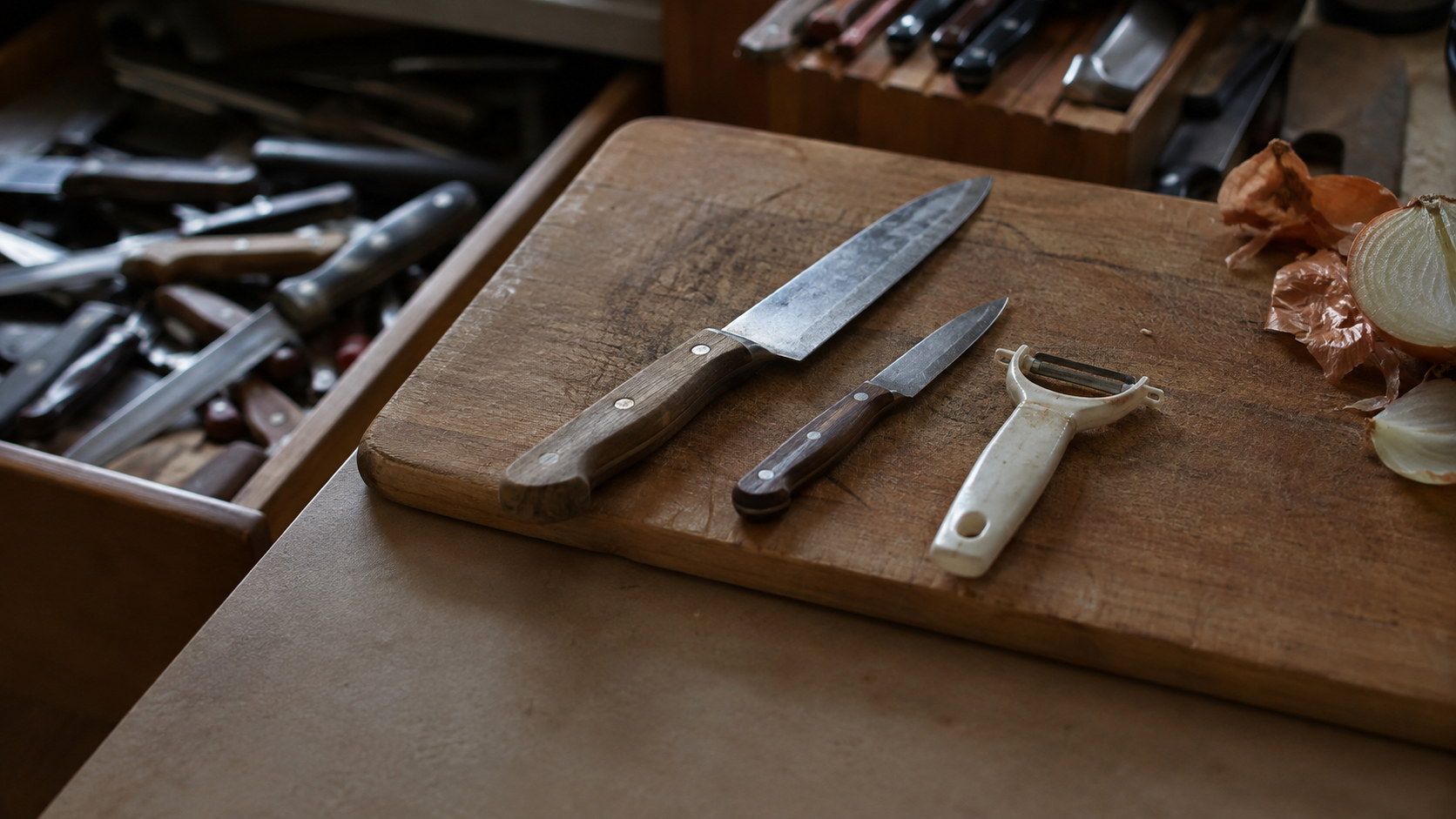
The chef's knife (the one that does 90% of the work)
Get one chef's knife of around 20cm, with a comfortable handle, in a steel that holds an edge but isn't a heritage piece you're afraid to use.
A €40 to €80 knife from a competent brand (Wusthof, Victorinox, the cheap end of Global) will outperform a €300 knife in the hands of someone who hasn't sharpened it.
Most home cooks need a knife that's slightly heavy, very sharp, and cared for once a month with a honing rod. That's it.
The paring knife (for the small things)
A 10cm paring knife with a thin blade does the things the chef's knife is too clumsy for: the eyes out of a potato, peeling a stubborn onion skin, segmenting an orange, halving a tomato in your hand.
A good one costs €15. A great one costs €25. The difference will not be visible in your cooking.
The peeler (technically not a knife but it is)
A Y-shaped vegetable peeler. Buy two if you live with another adult, because they always end up in a drawer in the wrong place.
The Kuhn Rikon model, in any colour, costs three euros and will outlast your friendships. Anyone who tells you to "use your paring knife instead" has not peeled a potato in twenty years.
What you do not need
Bread knives are useful if you eat a lot of crusty bread and don't have a chef's knife sharp enough to cut it. Most chef's knives, sharp, will cut bread fine.
Cleavers are theatrical. Boning knives are for people who break down whole animals at home, and if you do, you already have one. Steak knives matter for two times a year. The "santoku" you bought because everyone has one is just a slightly different chef's knife with a Japanese accent. The fish filleting knife is genuinely useful only if you fillet fish, which you should let your fishmonger do anyway.
The thing that actually matters: sharp
Three sharp knives beat seventeen dull ones every time.
A dull knife is dangerous (it slips), slow (it crushes more than it cuts), and depressing (it makes everything take twice as long).
Buy a honing rod for €15. Use it once a week, four pulls per side, before you cook. Get the knives professionally sharpened twice a year. A knife sharpening shop charges €5 a knife and will hand back something that feels like a new tool.
If you have done all of the above, your three-knife setup will outperform every collector's drawer. The seventeen other knives you didn't buy are all earning interest in the bank account you didn't drain to buy them.
So: how to actually sharpen it
The section above is the most important in this note and it leaves you with a
verb and no method. Here is the method.
A honing rod is not a sharpener. The steel rod that came with the block does
not remove metal, it pushes a rolled edge back into line. Use it often, ten
seconds before you start cooking, and the knife stays usable for months longer.
It will not rescue a genuinely blunt knife because it was never sharpening it in
the first place.
A whetstone is the real answer, and it is easier than it looks. A combination
stone, 1000 grit on one side and 3000 on the other, costs 25 to 40 euros and
lasts a decade. Soak it, hold the blade at roughly the angle of two stacked
coins, and draw it along the stone with light pressure, the same number of
strokes each side. Ten minutes, three or four times a year.
The internet will tell you the angle matters enormously. It matters much less
than being consistent, and a knife sharpened slightly wrong by you cuts far
better than a knife sharpened perfectly by nobody.
Or pay somebody. Most markets have a stall, most Italian towns have a
sharpener, and hardware shops often send knives away. Four to eight euros a
knife, twice a year. If you are never going to buy a stone, this is not a
compromise, it is simply the version that actually happens.
The test. Hold a sheet of paper by one corner and slice down through it. A
sharp knife takes it cleanly. A blunt one tears or slides. That takes four
seconds and it is more honest than looking at the edge.
How you hold it, which nobody tells you
A sharp knife held badly is still slow and still dangerous, and this takes two
minutes to fix permanently.
Pinch the blade, do not grip the handle. Thumb and forefinger on the flat of
the blade just in front of the handle, remaining fingers wrapped around the
handle. It feels wrong for about a day and then feels like the only sensible way
to hold anything. It gives you control from the wrist instead of the elbow,
which is where all the accuracy is.
Curl the other hand. Fingertips tucked under, knuckles forward, and the flat
of the blade rides against your knuckles as you cut. Your fingertips are
physically behind the blade rather than in front of it. This is the entire
technique for not cutting yourself and it takes one meal to learn.
Let the knife move forward, not down. A chef's knife slices on a forward
push or a backward pull. Pressing straight down is what makes an onion bruise
and a tomato squash.
The board matters more than the second knife
If you are choosing between a better knife and a better board, buy the board.
Wood or plastic, never glass. A glass board blunts a knife in a single
session, and the sound alone should have warned everybody off years ago. Wood is
kinder to an edge, plastic goes in the dishwasher, and both are fine.
Big enough to work on. Roughly 30 by 40 centimetres. The small one you own
is why vegetables end up on the worktop, and why chopping feels fiddly.
Put a damp cloth under it. A board that slides while you cut is the second
most common way people hurt themselves in a home kitchen. A wet tea towel
underneath costs nothing and ends it.
That is the whole kit: one sharp chef's knife, one paring knife, a peeler, one
big board and a cloth. Everything else in the shop is for somebody with more
cupboard space than cooking to do.