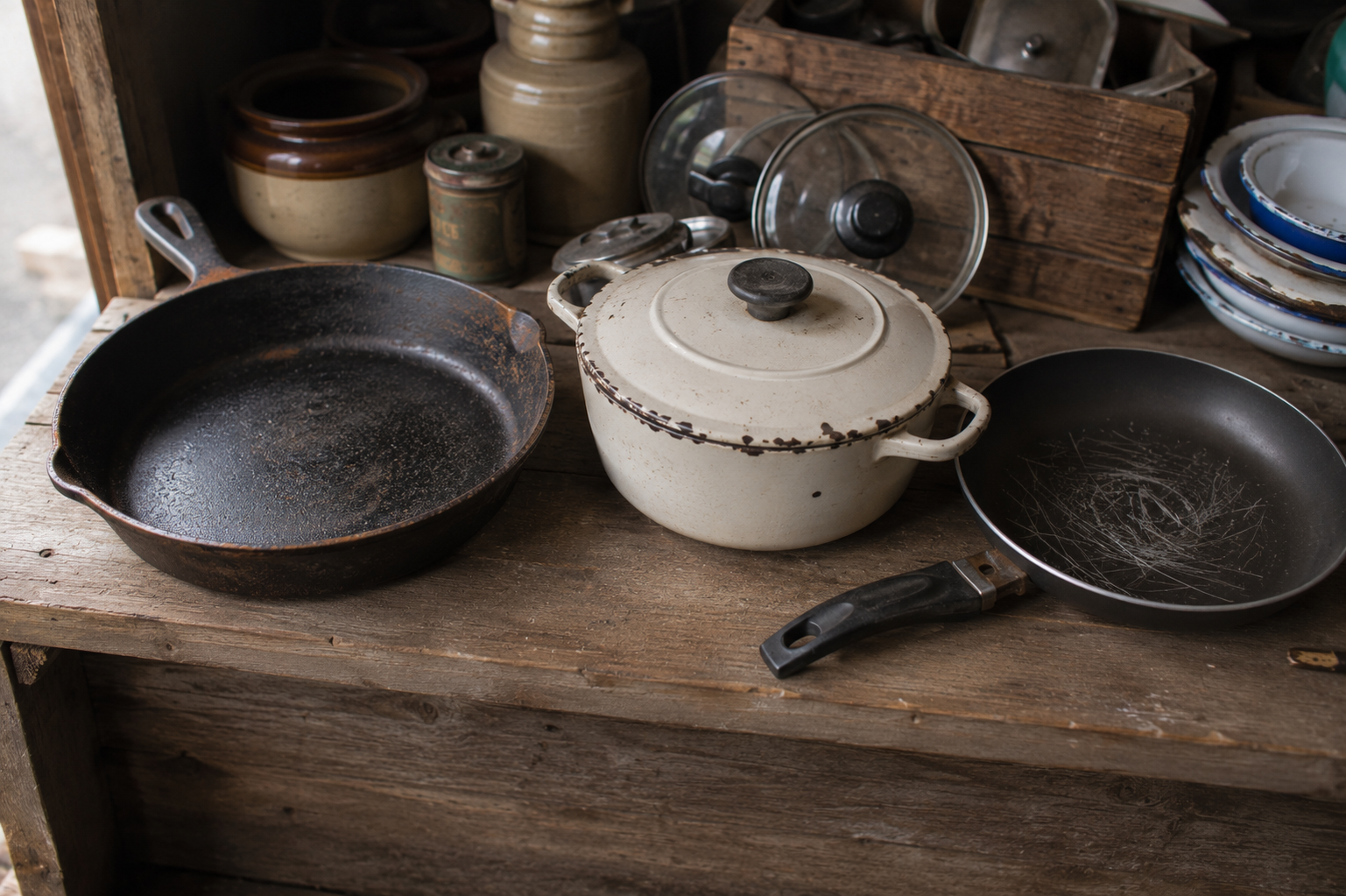
Buy used: cast iron, every time
A used cast iron frying pan is almost always a better buy than a new one.
The seasoning is already there. The hot spots have settled. The handle has softened from years of use.
You can find them at flea markets, second-hand kitchen shops, online classifieds for ten to thirty euros for a piece that retails new for sixty to a hundred and twenty.
What to look for: a smooth, even cooking surface (not pebbly). A flat bottom that sits on the hob without rocking. Some surface rust is fine; you can scrub it off and re-season in twenty minutes.
Run away from cracks, chips on the rim, or warping you can see when the pan is on a flat surface.
Otherwise, take it home, wash it, dry it on the hob, rub a thin film of oil on it, bake at 200°C for an hour. You now have a pan that will outlive your grandchildren.
Also fine used: enameled Dutch ovens, mortars, copper
A Le Creuset Dutch oven that retails for three hundred euros costs sixty in a charity shop. The enamel will have a couple of small chips inside (cosmetic, not functional). The thing braises lamb shoulders identically to the new one.
Same logic for stainless saucepans, copper, marble mortars. All of these are designed to be used hard for decades. Used means broken-in, not broken.
Do not buy used: anything non-stick
This is the one.
Non-stick coatings have a finite life. Once they're scratched, the coating starts to degrade and may release things you do not want in your dinner.
A used non-stick pan is a coating with an unknown number of scratches and an unknown amount of life left. You cannot tell from a glance how worn it is.
Buy a new non-stick pan, treat it gently (no metal utensils), accept that it will last three to five years, and replace it. Forty euros every five years is fine. Inheriting one is not.
Also be wary of: anything with a non-removable handle
Old Italian moka pots, which seem like they should be a great buy used, often have aluminium that has been heated to death and a gasket that needs replacing.
Coffee gear is one of those categories where the savings disappear into refurbishment.
The three pans that cover everything
The article so far is about how to buy. This is what to buy, and it is a short
list because a small kitchen punishes ambition.
A wide sauté pan with a lid, 26 to 28 cm. The single most useful object in
the kitchen and the one most people do not own. Deep enough to hold a litre of
liquid, wide enough to brown, and with a lid it becomes a braising pot. Almost
every one-pan dish in this book happens in this pan. If you buy one thing after
reading this, buy this.
A pot, 4 to 5 litres. Pasta, soup, stock, beans. Nothing exotic: a stainless
one with a heavy base is 20 to 30 euros new and will outlive you.
A small frying pan, 20 cm. Eggs, toasting nuts, one portion of anything.
This is the one that should be non-stick, and therefore the one you replace
every few years and buy new.
That is three. A cast iron pan is a wonderful fourth and it is a luxury rather
than a necessity, whatever the internet says about it.
What non-stick actually costs
Worth doing the arithmetic, because non-stick is the one category where buying
cheap repeatedly is genuinely the right answer.
A non-stick coating has a life of two to four years in a kitchen where it is
used weekly, less if it meets metal or a dishwasher. Nothing you do makes it
last much longer, and a scratched one is worse than useless.
So: a 20 euro pan replaced every three years costs about 7 euros a year. An 80
euro pan with the same coating and the same lifespan costs 27. There is no
version of this where the expensive non-stick pan wins, because you are paying
for a body that will outlast a surface that will not.
Buy the cheap one, treat it gently, and replace it without sentiment. Save the
money for the sauté pan, which is a lifetime object.
Rescuing a cast iron pan
Since the article recommends buying cast iron used, here is what to do when it
arrives looking like an archaeological find.
Surface rust is not a problem. Scrub it off with steel wool and a little
washing-up liquid. Yes, washing-up liquid: the fear of soap on cast iron applies
to a seasoned pan, and this one is being taken back to bare metal anyway.
Dry it immediately and completely, on a low hob for a couple of minutes. Bare
cast iron left wet will rust again within the hour.
Then season it. Rub a very thin film of neutral oil over the whole pan,
inside and out, then wipe it as though you were trying to remove all of it. Too
much oil is the single most common mistake and it produces a sticky varnish
rather than a hard surface. Into a 220 degree oven, upside down, for an hour.
Let it cool in the oven.
Two coats and it is better than most new pans. Then simply cook in it, especially
things with fat in them, and it improves for the rest of your life.
What kills it: long simmering of tomatoes and other acidic things, which
strips the seasoning, and the dishwasher, which strips it faster. Cast iron is
for browning, not for a two-hour tomato braise. That is what the sauté pan is
for.
What a pan is actually doing
Worth thirty seconds of theory, because it explains every buying decision above.
A pan does two jobs and they pull in opposite directions. It has to get hot
and stay hot when cold food hits it, which wants mass. And it has to respond
when you change the heat, which wants the opposite.
Cast iron is all mass. It takes five minutes to heat and holds that heat
through anything you put in it, which is why it browns so well and why it is
hopeless when you need to stop a garlic clove burning right now.
Thin stainless is all response and no mass. It heats in ninety seconds and drops
temperature the moment food goes in, which is why cheap thin pans steam
everything.
What you actually want for most cooking is the middle: a heavy base for mass,
thinner walls for response. That is what "heavy-bottomed" means on a label, and
it is the only word on the label worth reading.
This is also why the wide sauté pan earns its place over everything else. Enough
base to brown, enough width that two portions are not stacked, and enough
response that you can rescue the garlic.
What to actually shop for in a secondhand shop
Walk in looking for cast iron of any size, Dutch ovens, copper, stainless steel pans of nice weight, marble mortars, wooden cutting boards, thick stainless mixing bowls.
Ignore most appliances, all non-stick, anything with cracked plastic, anything labelled "as seen on TV."
Walk out with one good thing for the price of a takeaway. Use it for forty years.
The patient kitchen is the cheap one. The impatient kitchen has three drawers full of things bought new at the Saturday afternoon panic moment.