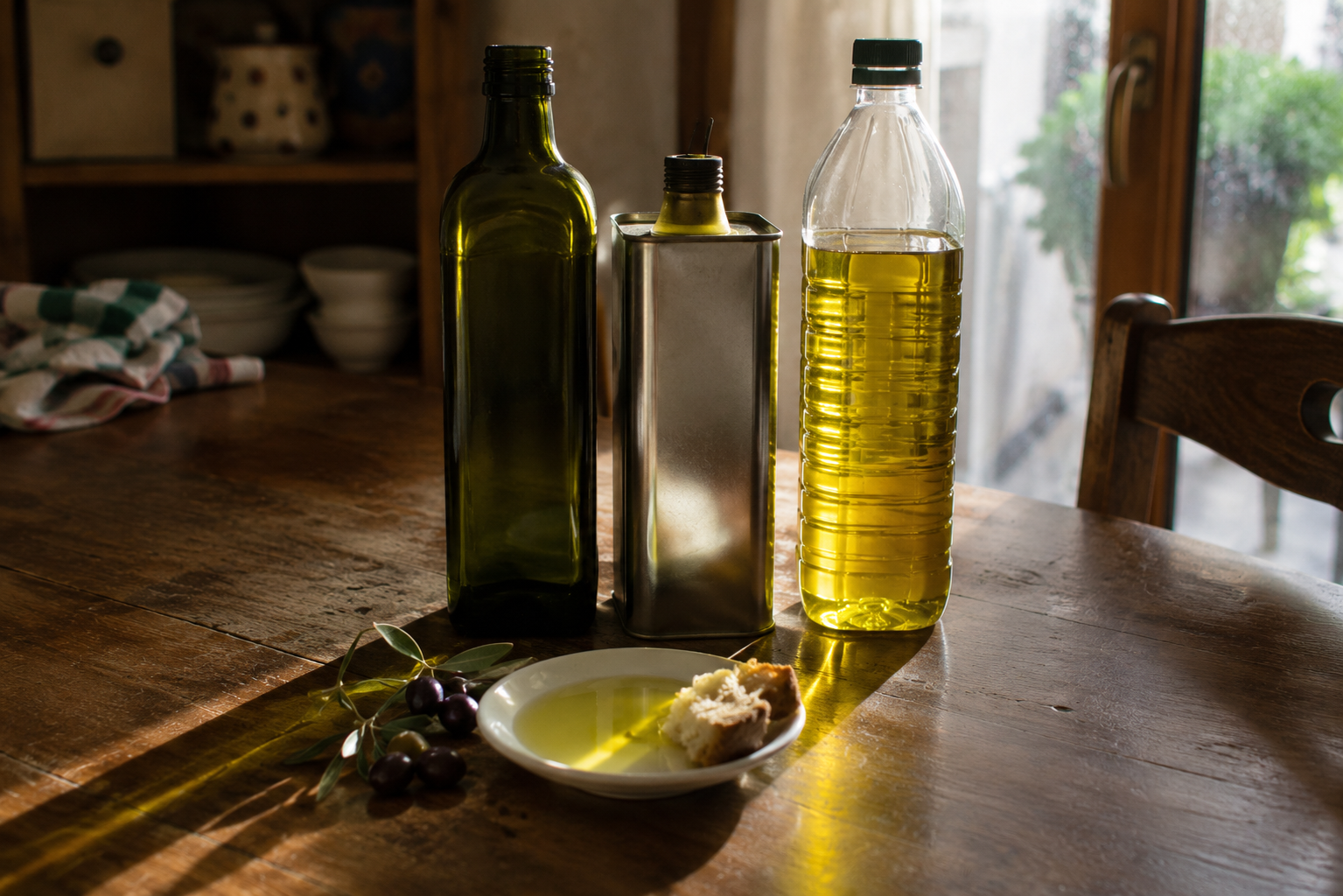
You need two bottles, not one
The biggest mistake home cooks make is buying one expensive olive oil and using it for everything.
Frying with €30 olive oil is a small crime against agriculture; finishing a salad with €4 olive oil is a small crime against your own dinner.
You need two.
The cooking oil. A good but unromantic extra virgin olive oil that you cook with, dress everyday salads with, and pour onto bread without thinking. Around €8 to €15 a litre is the sweet spot. The supermarket house brand is often fine. Avoid bottles labelled "olive oil" without "extra virgin" (those are refined, mostly flavourless), and avoid the suspiciously cheap ones (often blended).
The finishing oil. A small bottle of a single-estate or single-region olive oil, drizzled at the end on a piece of fish, on burrata, on a soup, on grilled vegetables. €15 to €30 for 250ml. Used in tablespoons, not pours. One bottle lasts months. The good ones taste of grass, pepper, artichoke, depending on the harvest. The great ones make you stop talking mid-sentence.
How to read a label
Three things to look for, and one to ignore.
Look for the harvest date. Not the "best by" date. The harvest date. Olive oil is at its best the year of harvest and declines after that. A bottle without a harvest date is a bottle that hopes you don't notice.
Look for a single country (and ideally a single region). "Product of Italy/Spain/Greece" is fine. "Packed in Italy from oils sourced from EU and non-EU countries" is a polite way of saying "we have no idea where this came from."
Look for the bottle. Dark glass or tin protects the oil from light. Clear bottles look pretty in marketing photos and damage the oil on the shelf.
Ignore prizes, medals, and gold seals. Some are real, most are bought, and you cannot tell the difference. Trust the harvest date and your tongue.
How to actually taste it
Pour a teaspoon into a small glass. Warm it with your hands. Sniff. It should smell of grass, fruit, sometimes tomato leaf, sometimes fresh almond.
Sip. Let it coat your tongue. Good olive oil is bitter on the back of the throat and sometimes makes you cough. That cough is not a defect. It is the polyphenols, which is also the reason the oil is good for you.
Rancid oil tastes like crayons. Cut oil tastes like nothing. If yours tastes like nothing and you paid €25, you got rolled.
Storage matters more than you think
Olive oil has three enemies: light, heat, air.
Keep your bottle out of direct sun, away from the hob (yes, even though this is the most convenient spot), and tightly closed.
A bottle that lives next to your hob will be flat and tired in three months. The same bottle stored in a cabinet will still be alive at six.
Keep the two bottles apart
One more piece of storage, and this one is about geography rather than
temperature.
Keep the cooking bottle and the finishing bottle in different places. Different
shelf, different cupboard, whatever it takes to make them non-interchangeable
when you reach out without looking.
This sounds fussy. It is insurance against the single mistake that actually
costs money: frying an onion in the twenty-five euro oil at 21:00, on autopilot,
because it was the nearer bottle. It happens to everybody who keeps the two side
by side, and it tends to happen exactly once per bottle.
How much you actually get through
People buy a small bottle because a large one feels like a commitment, and then
run out mid-recipe, which is how the wrong oil ends up in the pan.
Cooking the way this book does, olive oil is a structural ingredient rather than
a garnish. Two tablespoons to start almost every dish, more to finish. That is
somewhere around 30 to 50 ml a day if you cook most evenings, which is a litre
every three or four weeks.
So buy the litre. It is cheaper per unit, you will finish it long before it
degrades, and the bottle that is nearly empty is the reason people start
economising with the oil, which is the one place economising is a false saving.
The finishing bottle runs at a completely different rate: 250 ml lasts three to
six months, because it comes out in teaspoons. Buy that one small, and buy it
more often, because that is the one where a recent harvest date actually
changes what you taste.
The smoke point question, settled
Somebody will tell you not to cook with extra virgin olive oil because it has a
low smoke point. It is the most repeated piece of kitchen advice in Europe and
it is mostly wrong.
Extra virgin olive oil smokes somewhere around 190 to 210 degrees. Everything in
this book happens well below that: a gentle sauté of garlic is about 120,
softening onions about 140, and a properly hot pan for browning is around 180.
You are not deep frying, and if you were you would use a cheaper oil for reasons
of volume rather than chemistry.
Where the advice does apply: very high heat searing, and anything where the oil
sits hot for a long time. That is a small corner of home cooking and it is not
this book's corner.
What genuinely matters more than the smoke point is when the oil goes in.
Oil dropped into a screaming hot empty pan starts breaking down immediately. Oil
in a pan that is warming up, with the garlic already in it, never gets near its
limit because the garlic and the moisture keep the temperature down. Start
gently, and the question stops being a question.
The discount aisle is sometimes a gift
Once or twice a year, supermarkets put genuinely good olive oil on close-out for half price, usually because the harvest date is approaching the year mark.
If the date is recent and the price is silly, take six bottles. Use one immediately and store the rest in a dark cupboard.
You will eat better for the next year for less than you spent on whatever else you bought that day.
That's the whole game. Two bottles, a recent harvest date, and a tablespoon of attention to where they live in your kitchen.