When the scale saves you
Two cases. That's it.
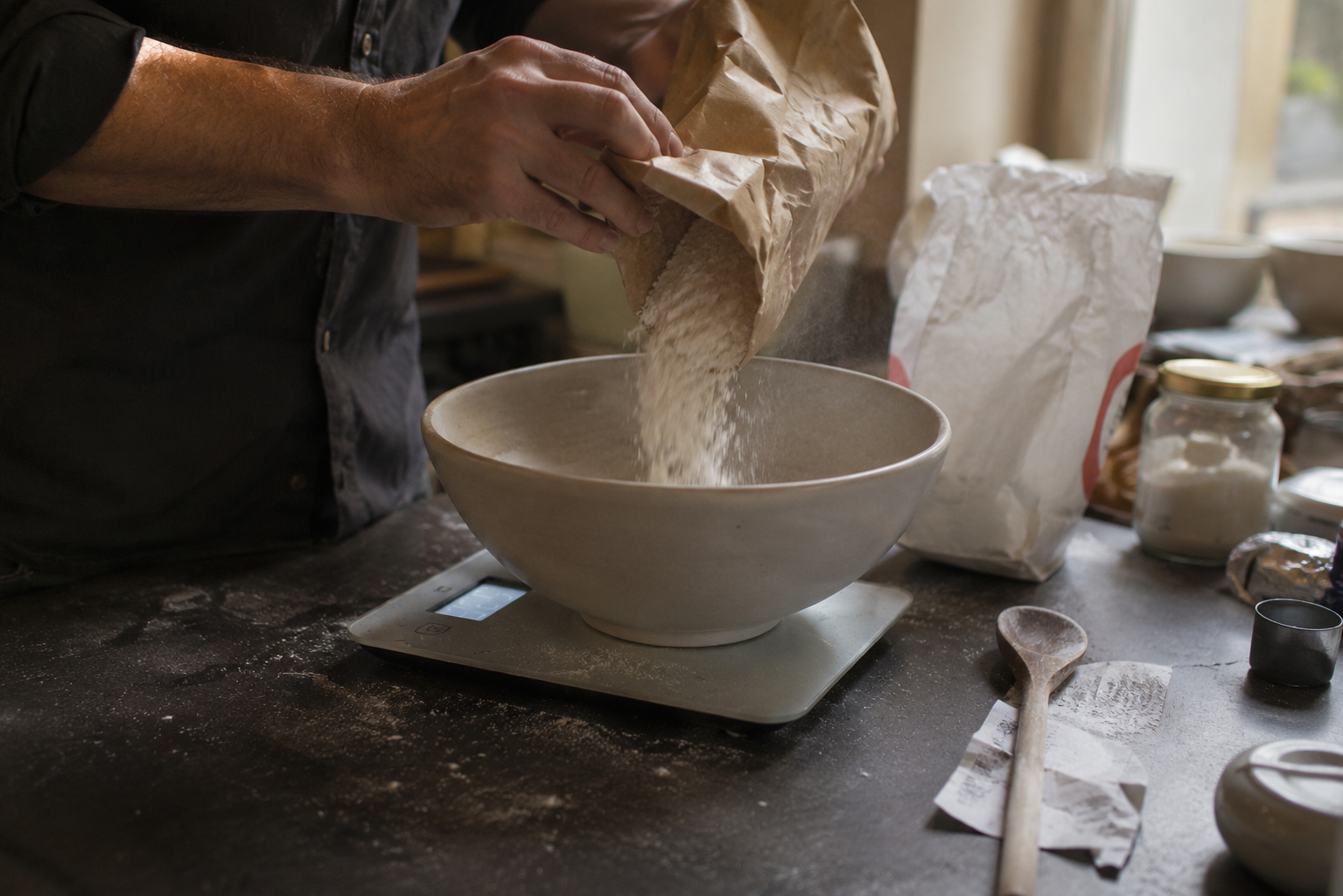
Baking. Cooking is geography; baking is chemistry. If a bread recipe asks for 500g of flour and you eyeball it with a cup, you'll be off by enough to change the texture of the bread. Buy a scale. The €15 one from any home shop is fine. Tare it, weigh, move on.
Pasta portions. Italian pasta portions are 80g to 100g per person dry. Most people serve 130g to 160g without realising, and then wonder why they're full and there's enough left over for nobody to take to lunch. A scale settles it instantly. Weigh once. After three weighs, you'll eyeball it correctly forever.
That's the whole list. Baking and pasta. Two things.
The portions worth weighing once
Pasta is the famous one, but the same trick works for everything you serve by
eye and consistently get wrong. Weigh each of these once or twice and your hand
keeps the knowledge for good.
- Dried pasta: 80 to 100 g per person. Eighty if the sauce is rich, a
hundred if it is thin or you have had a day. - Rice or farro for a salad: 70 to 80 g per person.
- Risotto rice: 80 g per person.
- Dried pulses: 60 g per person. Tinned pulses, drained: one 400 g tin
feeds two comfortably. - Potatoes, when they are the carbohydrate: 200 g per person.
The risotto number is the one nobody believes. Eighty grams looks like an
insult sitting in the bottom of a pan, and it produces a full plate, because
risotto rice roughly triples as it drinks the stock. Weigh it the first three
times and then never again.
When the scale turns you into a problem
Everywhere else.
Weighing the garlic. Weighing the parsley. Weighing the chunk of pancetta. The salt. The lemon zest. None of these things make your dinner better; they make your cooking slower and your kitchen weirder.
The whole dignified history of Italian home cooking happens with a wooden spoon, a pinch, and a glance. The grandmother making your favorite ragù has never weighed an onion in her life and the ragù is still better than yours.
If you find yourself weighing a clove of garlic, you have lost your way. Put the scale down. Cook by feeling. Adjust by tasting. Add salt slowly.
This is the actual skill, and it takes about six months of cooking weekly to develop. The scale will not speed it up. If anything, it will slow it down by giving you a number to hide behind.
The middle case: when you're new to a recipe
There is a sensible middle case. The first time you make a new dish, weighing the rice, weighing the meat, weighing the cheese for the sauce is not a sin. It's how you calibrate your eye.
After two or three goes, you'll know what 80g of risotto rice looks like in your hand, what 200g of guanciale looks like sliced. From then on, the scale stays in the cabinet.
This is the right relationship with the scale: a teaching tool, not a permanent companion.
A note on the milligram scale
If you have ever owned a milligram-precision scale for cooking, consider whether you have a hobby or a problem.
There is no dish in this cookbook that needs that level of precision. Coffee, maybe. Salt curing meat at home, fine. Otherwise, the spoon you have measures fine.
Volume, for the things you will never weigh
The argument above is that the scale belongs in a cupboard most of the time. It
only works if you know what the alternative measurements actually are, so here
they are, in millilitres, once.
- 1 teaspoon: 5 ml
- 1 tablespoon: 15 ml, which is three teaspoons
- 1 ladle: 80 to 100 ml, depending on your ladle. Worth filling yours with
water once and pouring it into a measuring jug, because every risotto
instruction in existence is written in ladles - 1 glass: 200 ml. The one you drink water from, not a wine glass
- 1 mug: 250 to 300 ml
- 1 tin of pulses or tomatoes: 400 g, which drains to roughly 240 g of
chickpeas or beans
Two of those are worth committing to memory because they turn up constantly: a
tablespoon of oil is 15 ml, and a drained tin feeds two.
The measurement that matters more than grams
Here is the one nobody weighs and everybody should think about: the size of
the pan.
Two portions of anything in a pan sized for one does not brown. It steams,
because the food is sitting in its own liquid, and it comes out grey and flat
rather than caramelised. No amount of accuracy about the 180 grams of sausage
compensates for that.
The rough rule is that food should sit in a single layer with space between the
pieces. If you can see the base of the pan between things, it will brown. If you
cannot, it will stew.
So the useful hierarchy, when a dish comes out disappointing, is: was the pan
big enough, was the heat high enough, was there enough salt, and only then did
the quantities matter. Almost nobody works down that list in the right order,
and the scale is a very comforting way of avoiding the first three.
The two-minute calibration
If you are going to weigh things for a week and then stop, spend the first two
minutes doing it properly, because what you are really doing is training your
hands.
Weigh 90 grams of dried pasta and then look at it. Not in the bowl: hold it in
your fist, or stand it in a bunch and look at the diameter, which for long pasta
is roughly a two euro coin. Do that three times and you will never need the
scale for pasta again.
Do the same for 80 grams of risotto rice held in a cupped palm, and for 150
grams of drained chickpeas, which is a little over half a tin and looks like
less than you expect.
Three measurements, three looks, two minutes. That is the entire useful
lifespan of a kitchen scale for most people, and everything after it is either
baking or a hobby.
The takeaway
Buy a basic kitchen scale. Use it for bread and pasta. Forget about it for everything else.
The day you find yourself weighing the herbs, take a long walk and reassess your priorities. There is dignity in cooking by hand and eye. The scale is for chemistry; the rest is craft.