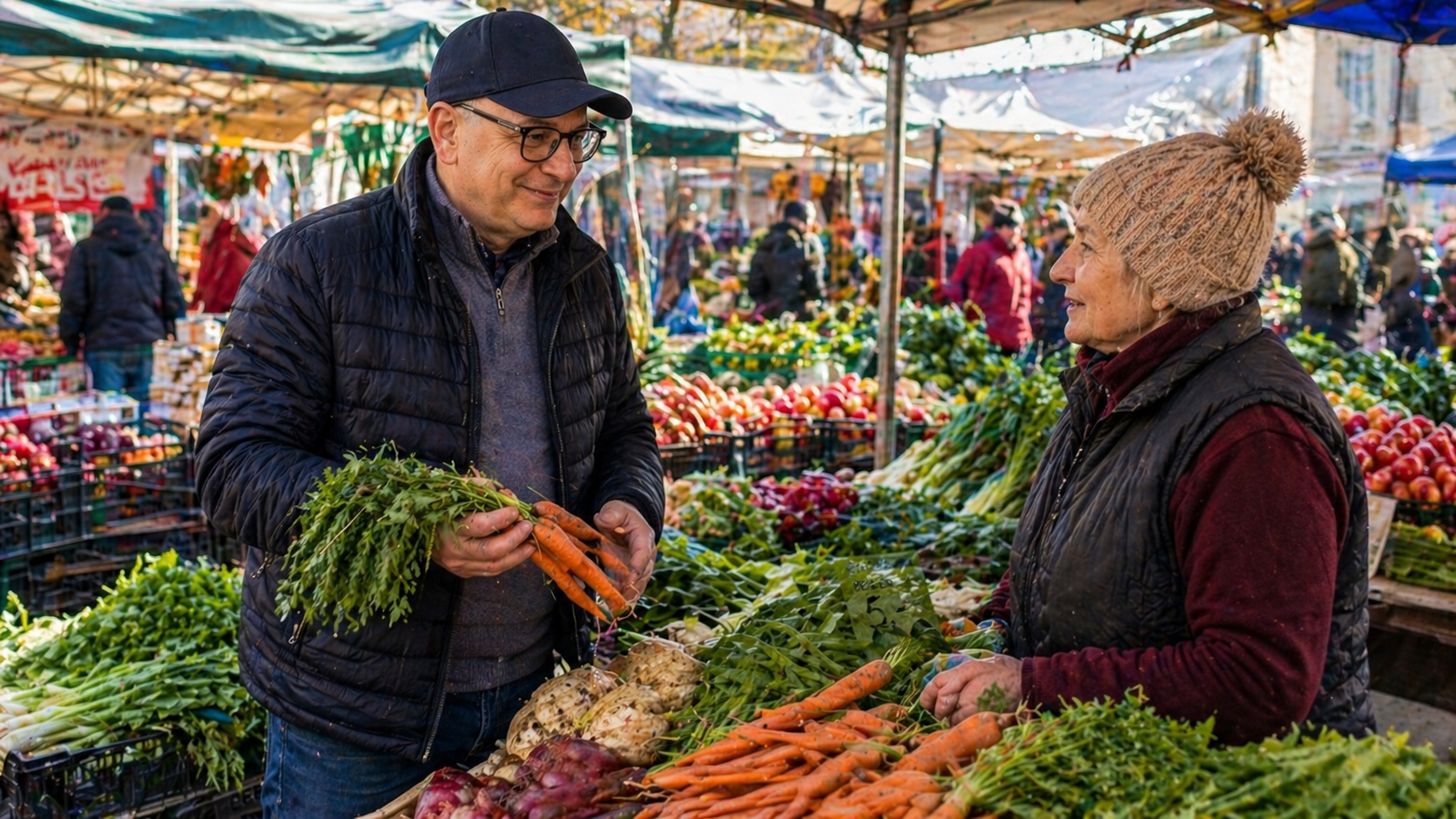
The market does the work for you
Shopping seasonally sounds like one of those wholesome lifestyle commitments that requires a tote bag, a notebook, and a complicated relationship with farmers. It isn't.
The vegetable that's in season this week is also the vegetable that's cheapest, the vegetable that's piled highest at the market, and the vegetable that's mysteriously included in three separate window displays at once.
The market is doing the calendar for you. You just have to walk past and notice.
Walk in curious, not certain
If you arrive certain you're cooking something with asparagus in October, you will pay for that certainty in both euros and disappointment.
Walk in curious instead. Look for the heap that's selling fastest. Sniff one. A peach in season fills the air around it; a peach out of season is silent and slightly resentful.
Pick up a fennel bulb and weigh it in your hand. If it feels heavier than it looks, it's full of water and was alive yesterday. If it feels light, it has been to too many parties.
Just ask
There is a polite way to get all this information without the squeeze test. Ask.
Italian markets reward the customer who asks. "Cosa è di stagione?" gets you the calendar; "Cosa mi consiglia?" gets you the seller's pride.
You will get a recommendation, often a small lecture, and occasionally a free sprig of something the seller insists you must put in the dish. None of this happens at a supermarket, where the produce is forced to introduce itself silently from behind plastic.
The cheat sheet you mostly already know
The seasons themselves you mostly already know:
- Spring: artichokes, fave, peas, asparagus, the first strawberries that aren't quite ready but you eat them anyway.
- Summer: the tomato's brief reign, plus zucchini, peppers, basil, aubergine, peaches, melon, and every fig that's ever existed.
- Autumn: porcini, chestnuts, pumpkin, the first cabbages, and the late grapes that taste like the year's apology.
- Winter: citrus carrying everyone on its back, plus radicchio, root vegetables, escarole, and the kind of cabbage that smells like it knows what's good for you.
Cook less, fail less
When ingredients are in season, you cook them less. A summer tomato wants olive oil, salt, basil, and silence.
The same tomato in January wants forty minutes with garlic, anchovy, and a glass of wine before it's prepared to make eye contact with you.
Cooking less also means failing less. There is more dignity in a plate of three things in season than in a beautifully composed dish whose hero ingredient was clearly imported under duress.
Where to buy what
Not everything should come from the same place, and the division of labour is
most of what makes shopping cheap.
The market, or the greengrocer: fruit and vegetables, and only what you will
eat in the next three or four days. This is where quality and price diverge most
sharply from the supermarket, and where asking a question actually gets you an
answer.
The counter, at the market or the supermarket: cheese, cured meat, olives,
anything you want 80 grams of. Buying a wedge of parmigiano at the counter costs
more per kilo than the shrink-wrapped block and less in total, because you buy
the amount you will finish.
The supermarket: everything with a long life. Tins, pasta, rice, oil,
vinegar, tinned fish, cleaning things. This is the boring trip and it is where
the own-brand advice applies: the cheap tin of chickpeas is the same chickpea.
The corner shop on your way home: the one thing you forgot, and the fresh
item for tonight. Yes, it is more expensive per unit. It is cheaper than a bag
of salad you bought on Saturday and threw away on Wednesday.
Nobody does all four every week. The point is that each one is good at a
different job, and the common mistake is doing the whole shop at whichever is
nearest.
The stall you go back to
The single biggest saving at a market is not a technique. It is going to the
same stall for three months.
What changes is not the price on the sign, which stays the same. What changes is
everything around it. You start getting told what is actually good today rather
than what is on the front of the display. You get the piece from the back. The
weight rounds down instead of up. You get handed something free to try, and once
or twice a year you get a genuinely serious discount on something they need to
move.
None of that is available to a stranger, and none of it requires charm. It
requires turning up, buying something, and saying hello the following week. Most
people never get there because they treat every market visit as a fresh
transaction.
If you buy from four stalls once each, you are a tourist four times. If you buy
from one stall four times, you are a customer.
Going late, and when it backfires
The last hour is when prices move. Traders would rather sell a crate at half
price than carry it home, and in the final thirty minutes at most European
markets you can fill a bag for very little.
Two honest caveats.
You get what is left, not what you wanted. This is fine if you cook from
what you have and a disaster if you arrived with a recipe. Go late with a bag
and no plan, or go earlier with a list.
Half of it needs cooking tonight. End-of-day produce is discounted because
it is at the end of its life, not because the trader is generous. A crate of
tomatoes at 2 euros is a bargain only if you make sauce that evening and freeze
it. Otherwise you have bought your waste at a discount, which is still waste.
The version that genuinely works: go late, buy one thing in bulk that you will
cook immediately, and buy the rest at the normal time.
The maths is also embarrassing
Out-of-season produce costs three to five times its peak. Buying in season is the closest thing to a discount you'll find without a coupon. Add the market over the supermarket and you're another twenty percent ahead.
The maths gets so good that I sometimes wonder if everyone else knows about it and is just being polite by not telling.
The best meal of the week is almost always something that was cheap this morning. The vegetables can sense it. They cooperate. They taste like they want to be there. That's the only secret, and the market hands it to you for free, every Saturday, if you have the dignity to put down the recipe and accept what's offered."