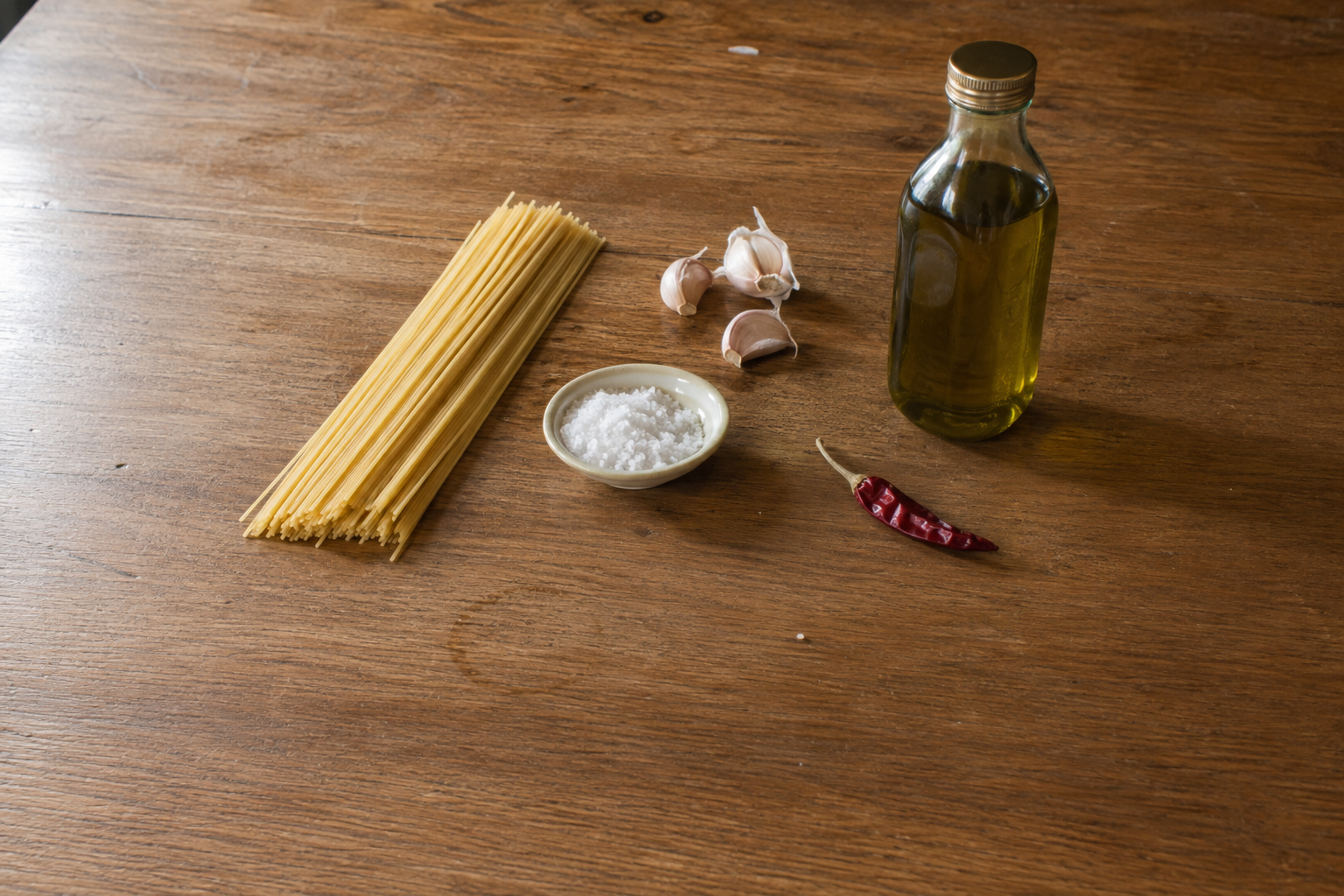
Why five
Five is not magic. The number could be four or six. It's just small enough to force a choice, and big enough that you don't have to be a monk about it.
It maps cleanly to a salt, a fat, a starch, a vegetable, and a protein, which is most of dinner. Or to a pasta, a tomato, a garlic clove, oil, and basil, which is also most of dinner.
The three patterns that make it work
Not every dish is a five-ingredient dish, but most weeknight ones can be. They fall into three patterns.
Pasta-and-something. Pasta + olive oil + garlic + one vegetable + parmigiano. Or pasta + tomato + basil + olive oil + chilli. Five ingredients, twelve minutes, lifetime of options.
Pan-and-something. A piece of fish or meat + olive oil + salt + lemon + one herb. Roast or pan-sear. Eat. Done.
Bowl-and-something. A grain + a tinned bean + a tinned fish + olive oil + lemon. The lazy salad of champions.
Pick a pattern, swap the variables, you have a year of dinners.
When to break the rule
Some dishes do not work at five ingredients and trying to force them is silly.
Ragù wants a soffritto (carrot, celery, onion: that's three before you've started), tomato, meat, wine, time. Risotto wants rice, broth, butter, parmigiano, onion at minimum. A real cassoulet has more ingredients than a small business has employees.
The rule is for the seventy percent of meals that are weeknight dinners. Not for the thirty percent that are hobby cooking. Knowing the difference is the actual skill.
The unexpected benefit: better shopping
Once you commit to five-ingredient cooking, the shopping basket changes.
You buy less. You buy fewer things you don't actually use. The bunch of dill you bought "in case" stops showing up wilted next Saturday. Your fridge gets less crowded. Your bin gets emptier.
The hardest part
The hardest part of the rule is resisting the sixth thing.
You will be cooking, the dish will be coming together, and you will think: "you know what would be nice? a splash of wine. some olives. a bit of chilli too." Resist. Let the four or five things you chose be the dish. Trust them.
If after eating you genuinely missed something, add it next time. This is how a recipe gets refined: by adding back, slowly, one thing at a time, only what was actually missing.
It's the opposite of how most home cooks work, and it's why a four-ingredient pasta in Naples tastes better than a fifteen-ingredient pasta anywhere else.
How to count, because the rule needs arithmetic
Every rule like this collapses the moment somebody starts arguing about what
counts, so here is the version that works.
Do not count: salt, pepper, olive oil, water. These are not ingredients,
they are conditions. A dish is not more complicated because it has salt in it.
Do count: anything that changes what the dish is. Garlic counts. Chilli
counts. A lemon counts. Parmigiano counts, and it counts as one whether you use
20 grams or 60.
Count a tin as one thing. A tin of tomatoes is one ingredient. A tin of
chickpeas is one ingredient. This is the rule that makes the whole thing work
for people cooking alone, because the store cupboard is where most of the
flavour is coming from.
Aromatics bought together count as one. Onion, carrot and celery, chopped
together as a base, is one move rather than three ingredients, and pretending
otherwise makes the rule useless for half of Italian cooking.
Count that way and most of the dishes in this book come out at four or five.
Count every pinch and every clove and nothing does, and you will abandon the
rule in a fortnight.
Five, worked
Abstract rules are unconvincing, so here are five real dinners and what the five
things are.
Pasta e ceci. Chickpeas, pasta, garlic, rosemary, passata. Twenty-five
minutes, one pan.
Eggs in purgatory. Eggs, tinned tomatoes, garlic, chilli, bread. Twelve
minutes, and the bread is doing half the work.
Courgette and potato frittata. Eggs, courgettes, potato, onion, parmigiano.
Thirty minutes and it is better cold the next day.
Tuna and cannellini salad. Tinned tuna, cannellini, red onion, parsley,
lemon. No cooking at all, and it improves overnight.
Trofie al pesto. Pasta, pesto, potato, green beans, parmigiano. Twenty
minutes, one pot, and it is a complete meal rather than a plate of carbohydrate.
Every one of those has a protein, a vegetable and a carbohydrate in it. That is
not a coincidence, it is the actual test of whether a five-ingredient dish is
dinner or just a side dish with ambitions.
The failure mode: five mediocre things
Here is the catch nobody mentions when they sell you a minimalist rule.
With fifteen ingredients you can hide a bad one. The tired tomato disappears
into the sauce, the cheap oil is masked by the garlic, and the whole thing
arrives at the table roughly fine.
With five, there is nowhere to hide. If the olive oil is flat, the dish is flat,
because a quarter of what you are tasting is olive oil. If the tomatoes are
watery, you are eating watery tomatoes with pasta in them.
So the rule has a second half that usually gets left off: fewer ingredients,
better ingredients. Not expensive ones. Better ones, which mostly means the
tin from a real producer rather than the cheapest on the shelf, and the oil you
would happily eat on bread.
The money works out. Five good things cost less than fifteen ordinary ones, and
you actually finish them.
Where the fifth ingredient should go
Given five slots and a protein, a vegetable and a carbohydrate already spoken
for, you have two left. Almost everybody spends them badly.
The temptation is to spend both on more substance: another vegetable, a second
tin. That produces a dish with more in it and no more character, which is the
specific failure of most weeknight cooking.
Spend one on fat with flavour in it and one on something sharp.
The fat is olive oil, or a cured meat, or a hard cheese. It carries flavour
around the plate, physically, because most of what you taste dissolves in fat
rather than water. A dish without one tastes thin no matter how long it cooked.
The sharp thing is lemon, vinegar, capers, olives, or a raw onion. It stops the
dish being flat, which is the single most common problem with simple food. If
you have ever made something that seemed correct and tasted boring, this was
almost always the missing slot.
Protein, vegetable, carbohydrate, fat, acid. That is five, that is dinner, and
it is roughly what every cheap Italian dish in this book turns out to be when
you take it apart.
A starter pantry for five-ingredient living
If your pantry contains olive oil, salt, dried pasta in two shapes, canned tomatoes, garlic, chilli flakes, parmigiano, anchovies, tinned cannellini, lemons, and a packet of basil seeds for the windowsill, you can hit dinner from any combination of the fridge and the cupboard for under ten minutes any night of the week.
That's the whole rule. Five ingredients, one pan, no apologies. The complicated dishes can wait for the weekend, when they belong.