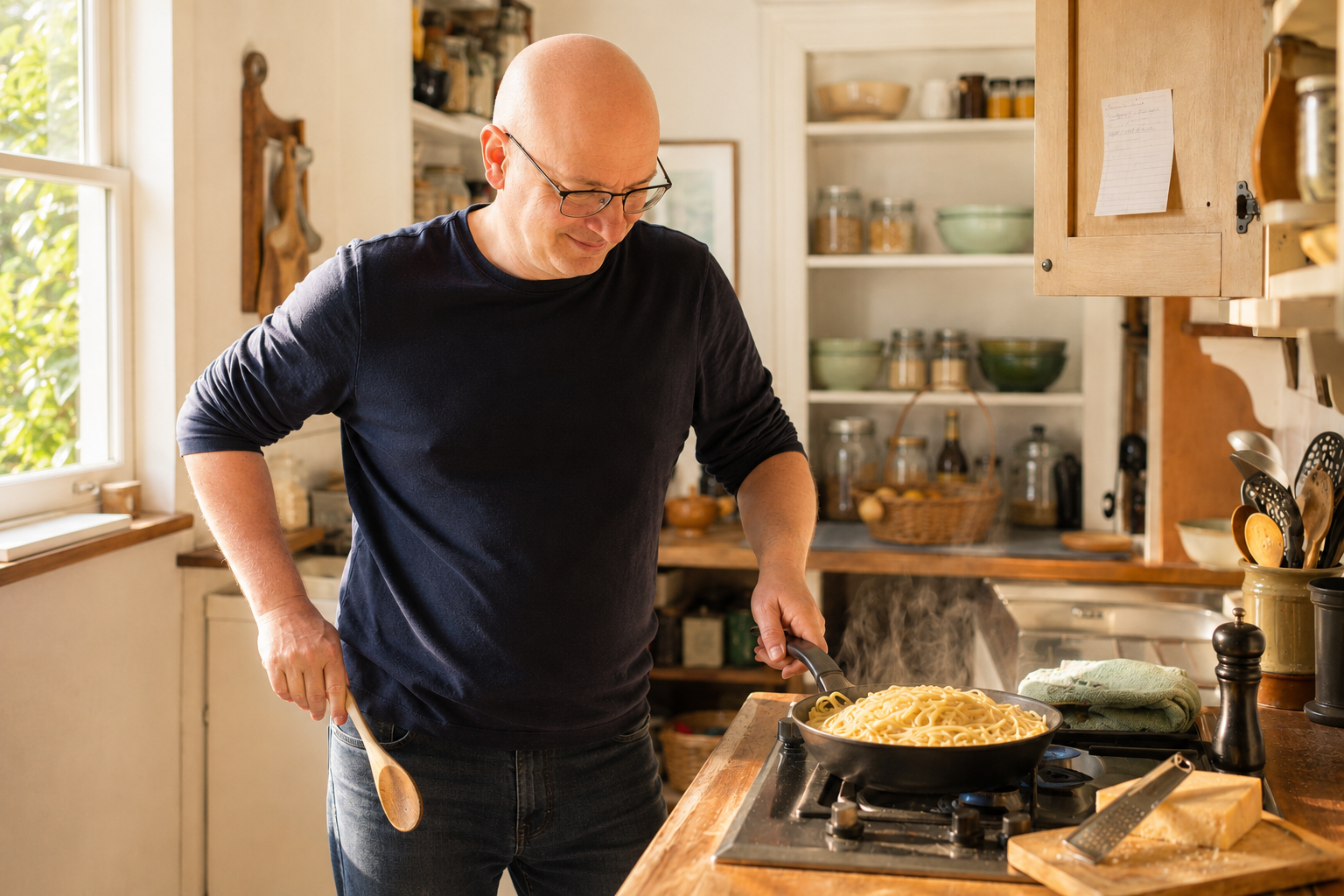
Step one: lower your standards on purpose
Tired-cooking does not mean "the dish you would have made if you had energy, but worse." It means a different category of meal entirely.
Pasta with butter and parmigiano is not a sad version of cacio e pepe. It is a complete dish in its own right, and one of the great consolations of Italian cooking. Once you accept that you are cooking from a different shelf of the menu, the pressure drops and the food gets better.
Step two: keep three triage meals on permanent standby
The trick is to know your own emergency menu before the emergency. Three is a good number. More than that and you'll spend the energy you don't have deciding.
My current three:
- Pasta in bianco with butter, parmigiano, and a crack of black pepper. Eight minutes, all from the pantry, embarrassingly good.
- Egg on toast with anchovies and olive oil. Ninety seconds, costs twenty cents, tastes like the south of France pretending to be poor.
- A bowl of tinned cannellini beans, warmed in their liquid with garlic, olive oil, and a pinch of chilli. Six minutes, no chopping, ridiculously satisfying.
Pick yours. Write them on a Post-it inside a cupboard. The decision is already made.
Step three: do less, not more
When tired, the temptation is to "make it nice" with a salad on the side, a quick sauce, a sprinkle of parsley you'll regret cutting. Don't.
The salad is for tomorrow, when you have hands again. Tonight is the burrata in front of the TV, the bowl of beans and bread, the egg on toast eaten standing up.
This is the dignity of restraint. Anyone can cook well when they have time. Cooking well when you have nothing left is a real skill.
Step four: the dish that still gets you a credit
Here is the magic part of the system. There is one dish that takes ten minutes, requires almost no thought, and somehow tastes like you tried.
It's pasta with garlic, olive oil, peperoncino, and a fistful of parsley. Aglio, olio e peperoncino.
You boil pasta. You cook three thinly sliced garlic cloves and chilli in olive oil while it boils. You toss them together with a splash of pasta water. You eat.
The total cognitive load is roughly equivalent to brushing your teeth, and yet you have made dinner. Italians have known this for two hundred years. They were tired too.
Step five: do not, under any circumstances, attempt heroics
This is the one rule that matters. Do not try, on a tired night, to cook a thing you've never cooked before. Do not try to use up the pile of strange greens in the bottom drawer. Do not be inspired by a video.
Tired-cooking is not creative time. It is muscle-memory time. Save the new recipe for Saturday morning.
Tonight is the dish your hands already know how to make, and there is no shame in it. There is, in fact, a small and underrated joy.
What being tired actually takes away
Worth being precise about, because the three kinds of tired need different
answers and most advice treats them as one thing.
Physically tired is the easiest. Your judgement is fine, you simply do not
want to stand up. The answer is a dish with no standing in it: something that
simmers while you sit down, or something that takes four minutes.
Decision-tired is the common one on a weekday, and it is the reason the
Post-it exists. You could cook. You cannot face choosing what to cook, and every
option you consider costs you something. Anything that removes the decision
works, which is why the three standby meals are written down rather than
remembered.
Flat, in the way a bad week makes you flat, is the one where cooking is
genuinely worth it, and the one where you are least likely to do it. Not because
the food is nutritious. Because twenty minutes of chopping and stirring is the
one activity in a modern evening that occupies your hands and asks nothing of
your brain. Plenty of people who do not think of themselves as cooks discover
this by accident and never quite explain it to anybody.
Diagnose which one you have and the answer picks itself. Physically tired wants
the beans. Decision-tired wants the Post-it. Flat wants the aglio e olio, made
slowly, with the radio on.
The three things you cannot run out of
The triage system has a single point of failure: it assumes the ingredients are
there. Discover at 21:00 that there is no parmigiano and the whole thing
collapses into a delivery order.
Three items carry all of it, and they are the three worth checking every time
you shop rather than every time you need them.
Pasta. Any shape, always in the cupboard, and never down to the last
portion. When you open the last packet, it goes on the list.
A hard cheese and a tin of something. Parmigiano or pecorino, wrapped
properly, plus tinned pulses or tinned fish. Between them they turn plain
carbohydrate into a meal.
Good olive oil and garlic. Half of what makes the tired dishes taste like
food rather than fuel is the oil, and this is the one night you should not be
economising with it.
Everything else in the emergency menu is optional. Those three are the system.
And the nights you do not cook at all
There will be nights when even seven minutes is more than you have, and a note
that pretends otherwise is not being honest with you.
Order the food. But order it like a decision rather than a collapse: choose it
before you are past the point of choosing, put it on a plate, sit at the table
and eat it properly. The difference between a takeaway that felt good and one
that felt like giving up is almost entirely whether you decided on it or
defaulted to it.
And if there is a portion of something in the freezer, this is the night it was
frozen for. Take it out before you sit down. That is the whole reason for
labelling things.