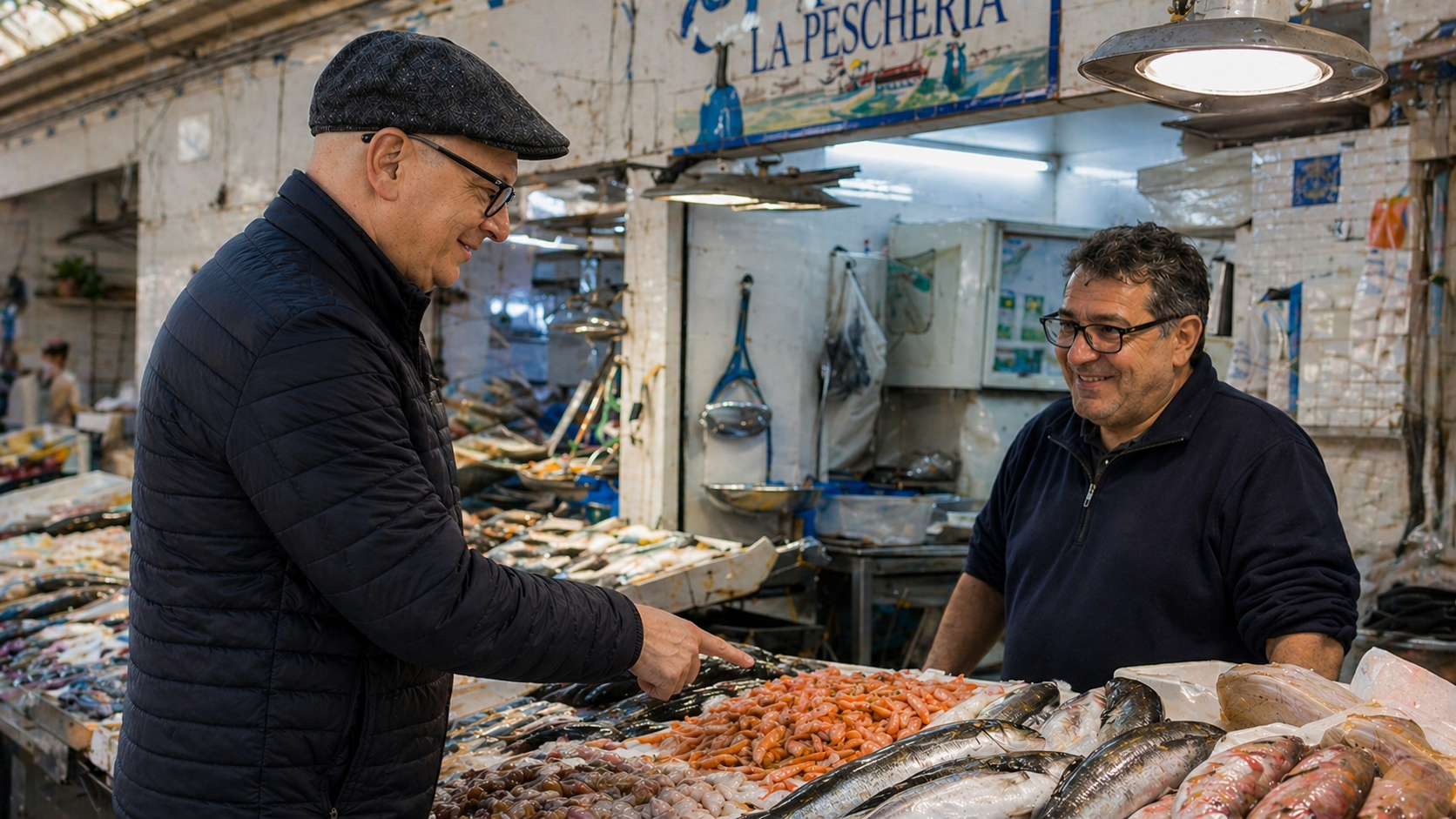
Timing matters more than you think
The first rule has nothing to do with what you're buying.
Mondays the case is leftover from the weekend, looking sad and reflective. Saturdays the case is busy, the prices are confident, and the seller has no time for you.
Wednesday or Thursday is the week's golden middle: deliveries are recent, customers are sparse, and the seller is open to actual conversation.
Show up midweek and the market starts to feel less like a transaction and more like a small kitchen advisory service that doesn't charge for advice.
Lead with curiosity
The biggest mistake you can make at the counter is to whisper your order as if asking for the answer to an exam. Lead with curiosity.
"Cosa è arrivato fresco oggi?" or "Cosa mi consiglia?" works almost everywhere. It gets you the freshest piece in the case and signals that you are not the kind of customer who wants to be quietly handed Tuesday's surplus.
Better still, abandon your recipe at the door. If sea bream went up overnight and mackerel went down, mackerel is a better dinner anyway, and you wouldn't know if you hadn't asked.
A brief medical exam, performed on a fish
When it comes to fish specifically, you are essentially performing a brief medical exam.
The eyes should be clear and slightly bulging. Sunken, cloudy, grey: the fish has had a long week, in another life.
Lift the gill cover. Bright red or pink is fresh; brown is old and faintly tragic.
Press the flank. The flesh should spring back like a friend pretending nothing is wrong. If your finger leaves a dent, walk away.
The smell test is the most honest one of all. Real fish smells like seawater. "Fishy" is the smell of a fish that has been out of the water too long and is asking the universe what it did to deserve this.
The good fishmonger is not insulted that you're checking. The good fishmonger respects it.
The fancy fish is mostly social climbing
The fancy fish, by the way, is fancy because rich people learned to like it once and never updated their list.
Mackerel, sardines, anchovies, mussels, squid, octopus, palamita: all under-loved, all delicious, all costing a fraction of branzino or orata.
Buy whole rather than filleted whenever you can. Cheaper per kilo, fresher (you can see the eyes and the gills doing their thing), and the bones become a stock for next week's risotto.
Frozen at sea is also fine, often better than "fresh" fish that has been sitting on ice for four days while everyone agreed it was fresh.
Meat: same idea, different organs
The expensive cuts are expensive because they are tender, not because they have more flavour. The cheap cuts are where the flavour lives, and they are forgiving of a beginner cook in a way that a tenderloin will never be.
Beef shin, pork shoulder, lamb neck, ossobuco, chicken thighs, oxtail: all braise into the kind of meal you remember weeks later. Tenderloin merely makes you nervous.
Colour matters too:
- Beef: deep red. Bright pink is too fresh and hasn't aged; grey is too old.
- Pork: pale pink.
- Chicken: cream-coloured. Yellow or grey means the bird had a hard week.
And the white streaks of fat through the muscle, what the fancy people call marbling, are not a defect. They are the future flavour of your meal, melting bravely into the sauce while you stand there pretending you knew that all along.
The butcher is a tool
The butcher is also a tool, in the kindest sense.
Removing silverskin, frenching a rack, butterflying a chicken: all of it costs nothing extra and saves you ten minutes and a ruined knife at home.
Buy whole birds and break them down yourself, or have the butcher do it. Either way you'll be twenty to thirty percent ahead, and you'll get a carcass for stock as a parting gift.
There is also a humble piece of furniture in every Italian butcher's: the scraps board, where they sell yesterday's trim and odd ends for the price of a coffee. That, my friend, is where the best ragù of your life is currently hiding.
What is actually in season, roughly
The whole argument above depends on knowing what the calendar is doing, and
nobody tells you. Here is the short European version. Shift it a few weeks
earlier in the south and later in the north and it holds from Naples to
Stockholm.
Spring. Asparagus, artichokes, broad beans, peas, spring onions, the first
courgettes, rocket, new potatoes, radishes, strawberries towards the end. This
is the shortest and best season and most of it is over before you have noticed
it started.
Summer. Tomatoes, aubergines, peppers, courgettes, green beans, basil,
cucumber, stone fruit, melon, figs at the end. Anything that wants sun. A
tomato in August costs less than a tomato in February and tastes like a
different species, which is the whole argument in one ingredient.
Autumn. Pumpkin and squash, mushrooms, fennel, cabbage, leeks, chard, the
last peppers, grapes, pears, chestnuts. The best season for cooking and the one
most people ignore because the weather has turned.
Winter. Cabbage, cavolo nero, kale, leeks, cauliflower, broccoli, potatoes,
carrots, onions, celeriac, citrus. Especially citrus: oranges and lemons are at
their cheapest and best in January, which is exactly when you need them most.
All year, and genuinely fine: onions, carrots, potatoes, garlic. These are
stored rather than seasonal, they are cheap in every month, and half this book
is built on them.
The two things worth buying out of season
Consistency demands an exception, so here are two.
Tinned tomatoes, always. A tin of Italian tomatoes picked and processed in
August is a better tomato in February than anything in the fresh aisle, because
it was ripe when it went in. Cooking with fresh tomatoes in winter is the one
piece of seasonal orthodoxy worth ignoring, and it is why almost every tomato
dish in this book starts with a tin.
Frozen peas and spinach. Frozen within hours of picking, and better than the
tired fresh version that has spent four days in transit. There is no snobbery
available here and anyone who tells you otherwise is not paying for their own
shopping.
What seasonality actually saves you
Numbers, because the argument is usually made on taste alone and the money is
just as persuasive.
A kilo of tomatoes in August runs around 1.50 to 2 euros in most of Europe. The
same kilo in February is 4 to 5, and it is a worse tomato. Asparagus in May is
half what it costs in November. Courgettes in July are a third of the December
price.
Across a year, cooking with whatever is cheap and abundant instead of whatever
the recipe demands is worth somewhere between 15 and 25 per cent of a vegetable
budget. That is not life-changing. It is roughly a month of shopping, for free,
in exchange for reading the price labels instead of a recipe.
The biggest trick is the laziest
The cheapest cuts cooked slowly will always beat the expensive cuts cooked badly.
Time, salt, and patience do more than money does, and they can be deployed by anyone with a pan and an evening.
Show up midweek, ask one question, buy what's good today, take the bones home for free, and let the slow cooking do the rest. That's the entire job.
The rest is just stories.